Spring Street Salt Shed
Dattner Architects and WXY's Spring Street Salt Shed had its first real test this past weekend, helping to dig out from New York City's second largest snowfall on record.
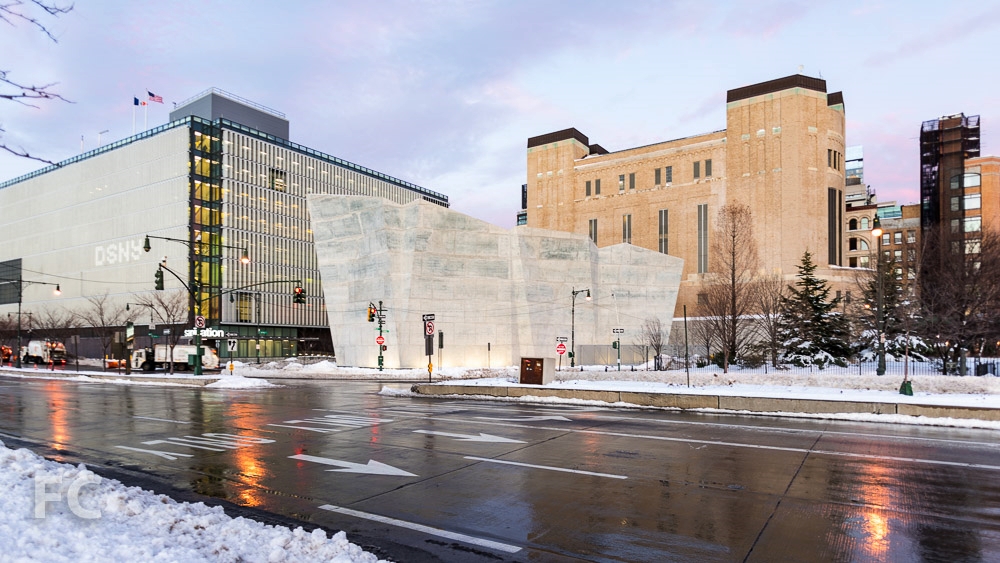
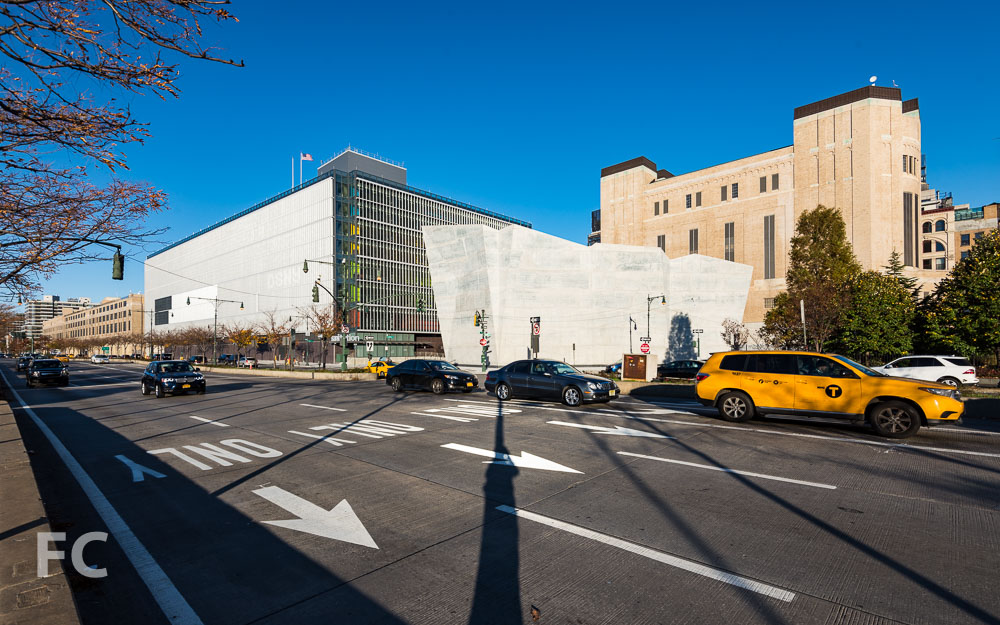
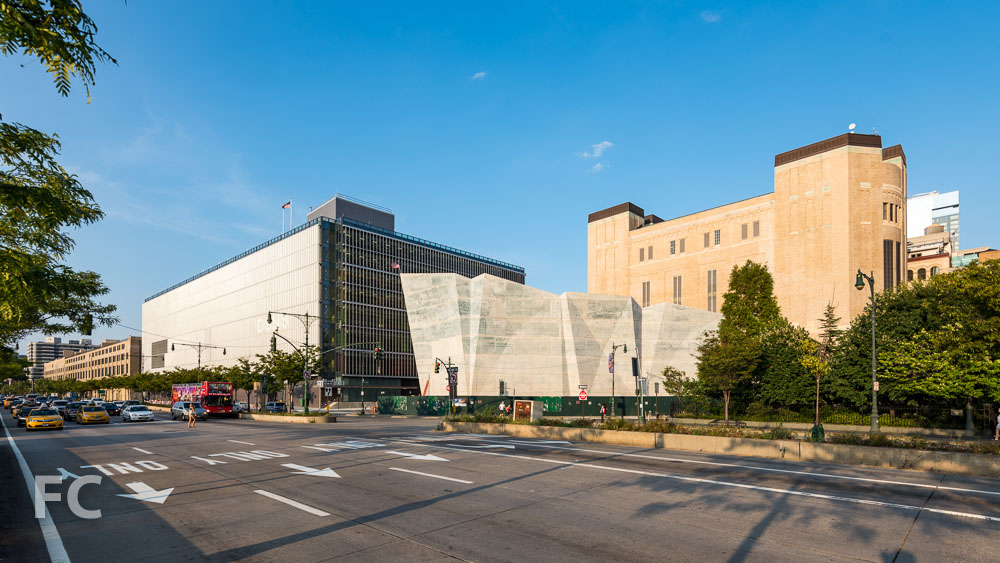
The onslaught of snow storm Jonas, New York City's second largest snowfall on record, brought the first real test for the city's new salt shed at Spring Street and the West Side Highway. Designed by Dattner Architects and WXY Architecture + Urban Design, the faceted concrete salt shed houses 4,000 tons of salt to combat the wintry precipitation. The form tapers towards the bottom, with glass pavers and lights installed along the periphery for dramatic uplighting of the structure at night. Entry gates along the Spring and Canal Street access points feature the "DSNY" identifier rendered in twisted vertical metal pickets, providing a graceful touch of design to what is often mundanely treated.
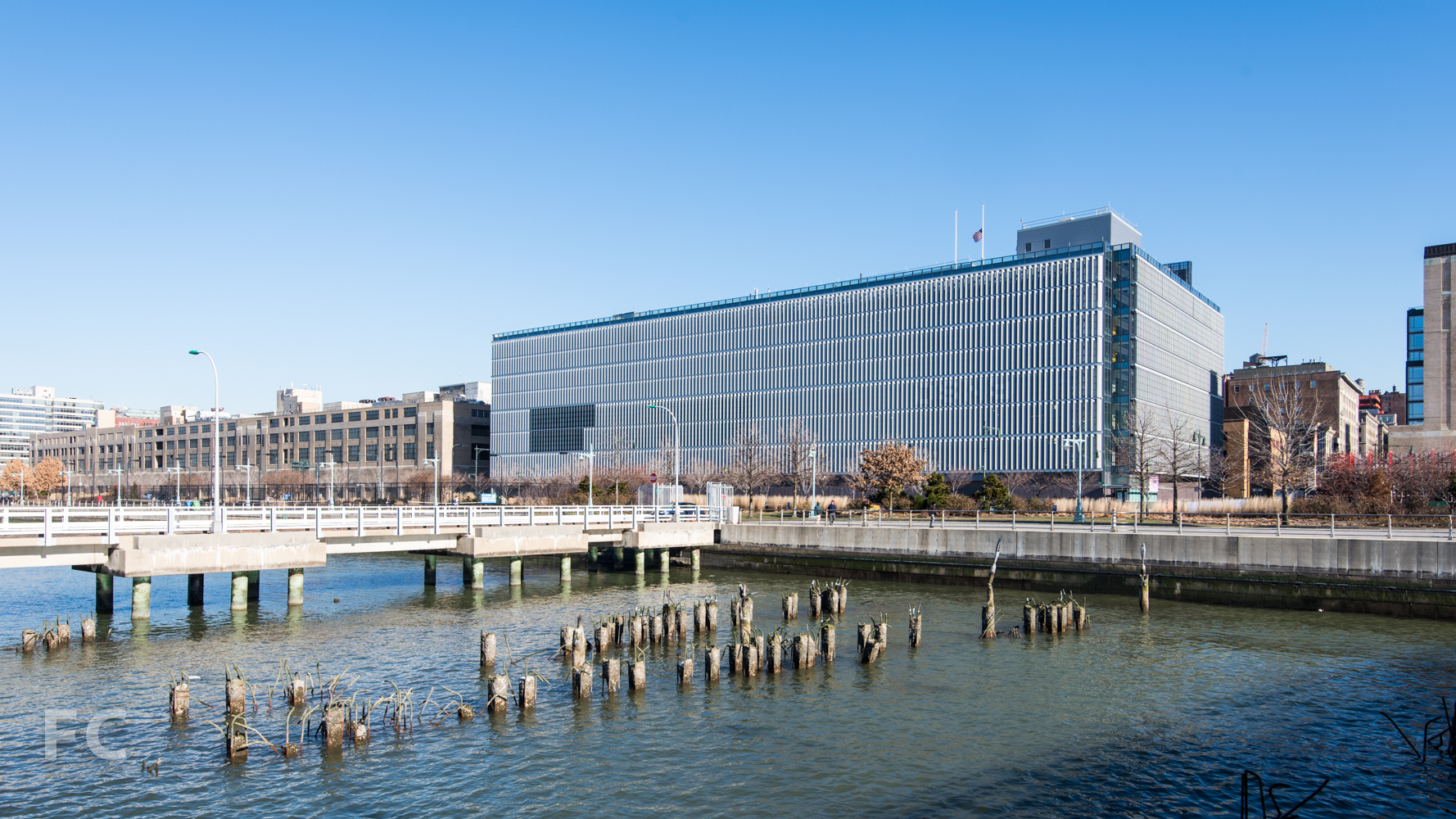
As a companion piece with the recently opened sanitation garage, the salt shed serves as a contemporary precedent for how urban infrastructure can serve to echo the values and aspirations of a city's architectural character.
Sanitation trucks head into the Manhattan Districts 1/2/5 Garage after a long day of plowing the aftermath of snow storm Jonas.
Looking south along the West Side Highway towards the Manhattan Districts 1/2/5 Garage (left) and the Spring Street Salt Shed (right).

The Manhattan Districts 1/2/5 Garage (left) and the Spring Street Salt Shed (right).
The Manhattan Districts 1/2/5 Garage (left) and the Spring Street Salt Shed (right).
Looking north along the West Side Highway towards the Manhattan Districts 1/2/5 Garage (left) and the Spring Street Salt Shed (right).

Southeast corner of the Spring Street Salt Shed.
Southeast corner of the Spring Street Salt Shed.
East facade of the Spring Street Salt Shed.
Close up of the sidewalk uplighting.
North facade of the Spring Street Salt Shed.
Northeast corner of the Spring Street Salt Shed.
Northeast corner of the Spring Street Salt Shed.
Looking west along Spring Street towards the Manhattan Districts 1/2/5 Garage (right) and the Spring Street Salt Shed (left).
Architect: Dattner Architects and WXY Architecture + Urban Design; Client: New York City Department of Sanitation; Program: Infrastructure; Location: Hudson Square, New York, NY; Completion: 2015.
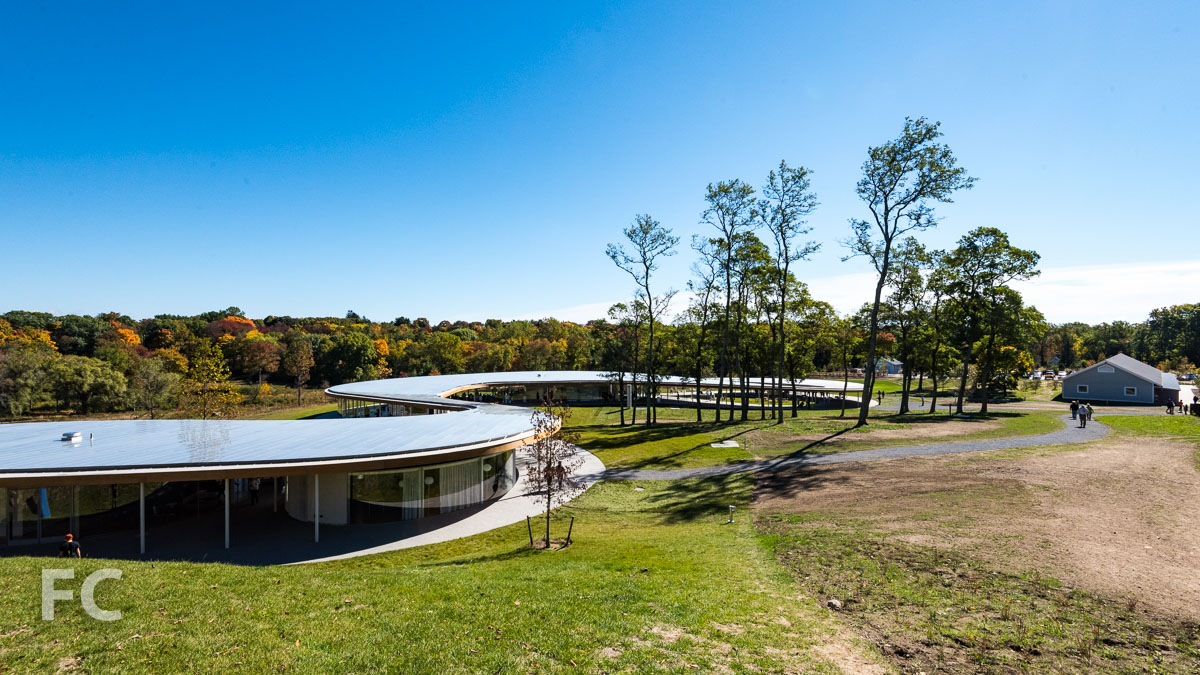
Grace Farms
The River Building with the Sanctuary in the foreground.
Entering the River Building at the Sanctuary.
The lobby of the Sanctuary.
Sanctuary.

Sanctuary.
The view from the stage inside the sanctuary.
The stage inside the Sanctuary.
Sanctuary.
Roof structure detail inside the Sanctuary.
Perimeter structure and glass enclosure detail inside the Sanctuary.
Glass enclosure detail at the floor of the Sanctuary.
Kazuyo Sejima and Ryue Nishizawa speaking at the opening day ceremony.
Roof drainage system at the Sanctuary roof.
Looking down at the continuation of the River Building from the Sanctuary.
An artist captures the River Building on his canvas.
Looking down at the continuation of the River Building.
The stairs leading down from the Sanctuary.
Looking back towards the Sanctuary.
The Library entry.
Shelving inside the Library.
Farm 56 by Thomas Demand inside the Library.
Conference room inside the Library.
Glass enclosure detail at the Library.
Pathway.
Double Glass River by Teresita Fernandez inside the Commons.
Double Glass River by Teresita Fernandez inside the Commons.
Detail of Double Glass River by Teresita Fernandez inside the Commons.
Lighting inside the Commons.
Looking toward the Sanctuary from the Commons.
Signage on the glass enclosure of the Court.
Looking down onto the basketball court.
Looking down onto the basketball court.
Looking down onto the basketball court.
The Court.
The Court.
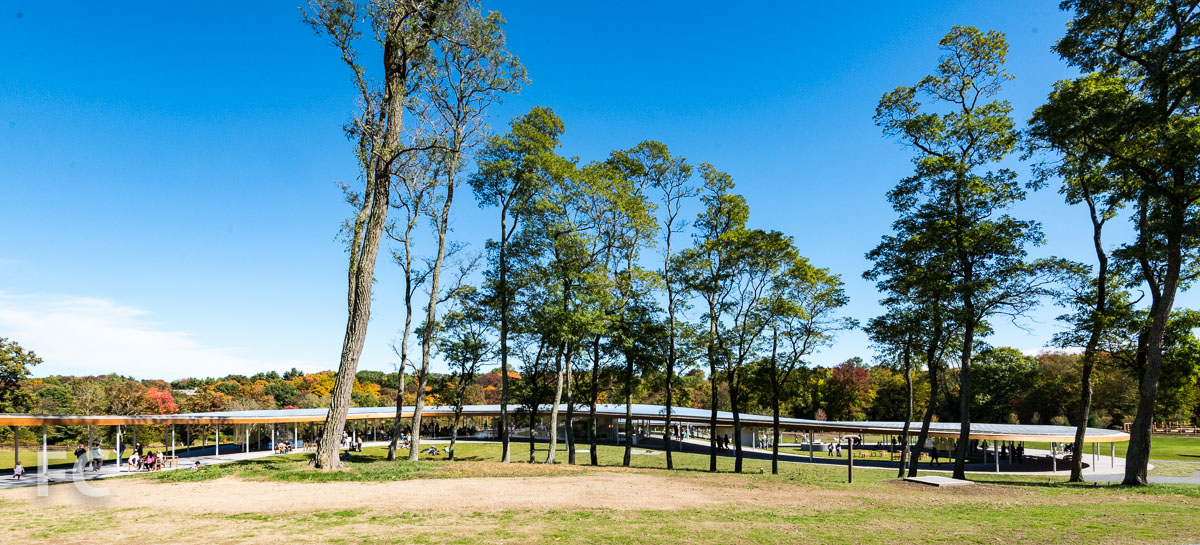
The River Building.
Looking towards the River Building from the Plaza and the East and West Barns.
Architects: SANAA (Design Architect) with Handel Architects (Executive Architect); Landscape Architects: OLIN; MEP Engineer and Lighting: Buro Happold; Structural Engineer: Robert Silman Associates; Building Envelope: Front; Construction Manager: Sciame; Graphics: Pentagram; Program: Church and Cultural Facilities; Location: New Canaan, Connecticut; Completion: 2015.
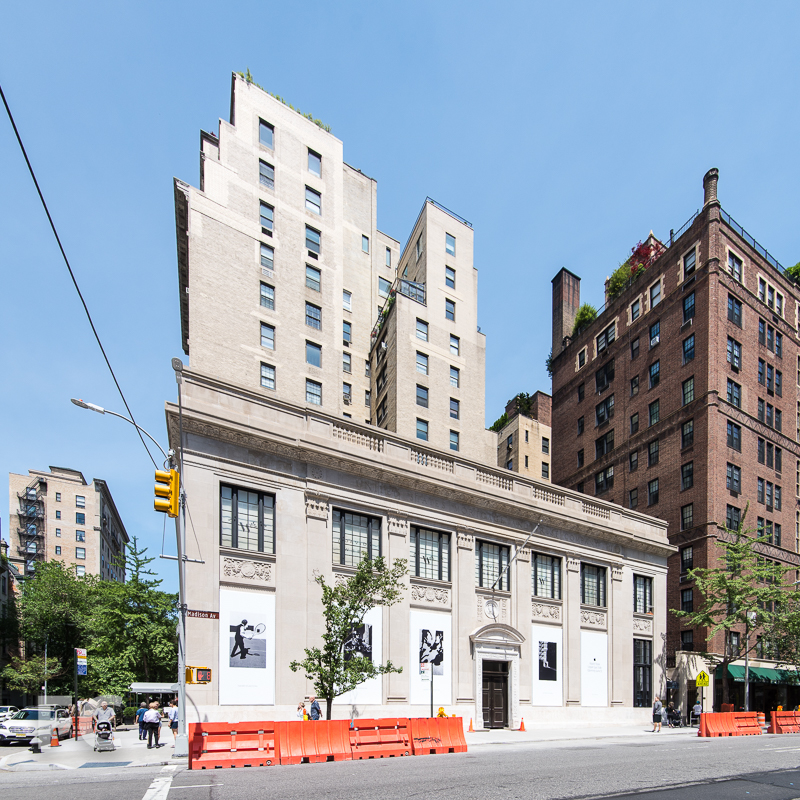
940 Madison Avenue - Apple Store - Upper East Side
The latest Apple Store in New York is set to open this Saturday in the Upper East Side neighborhood of Manhattan, at 940 Madison Avenue. In typical Apple fashion, the new store is located in a historic structure, the U.S. Mortgage & Trust Co. building, a two-story neo-Classical structure originally constructed in 1921 and designed by architect Henry O. Chapman, of Barney & Chapman. The 12,580-square-foot building features a limestone facade which looks to have been cleaned as part of the renovation. The entrance features Knoxville marble with bronze entry doors. Inside, supposedly Apple has kept the original tenant's bank vault, perhaps to store those fancy gold watches. Prior tenants included fashion brand V.B.H. which occupied a Peter Marino renovated space. The building still retains its fashion retail heritage as it houses jeweler David Webb, at the last northern bay and the second floor. Tthere is no word yet on whether Apple will eventually take over the entire building. A grand opening for the store has been set for this Saturday.
Southeast corner from Madison Avenue.
East facade from Madison Avenue.
Northeast corner from Madison Avenue.
Main entry on the east facade.
Entry door detail.
Exterior ornamentation at the entry door.
Cornerstone at the southeast corner.
Window detail at the east facade for the existing retail tenant.
Architects: Bohlin Cywinski Jackson; Program: Retail; Location: Upper East Side, New York, NY; Completion: June 13, 2015.



1 World Trade Center - One World Observatory
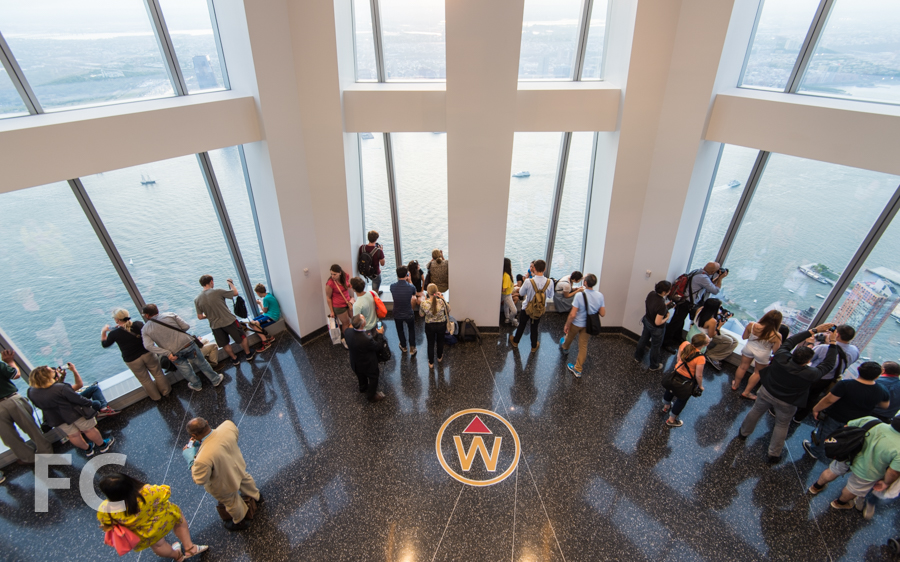
In yet another milestone at the World Trade Center site, the observatory at One World Trade Center opened to the public last Friday. Known as One World Observatory, the attraction reinstates views lost due to the tragic events of September 11. Almost 14 years later, the public can once again view the city from its highest point.
One World Observatory entry canopy.
Like much else in New York, the opening day was marred by long lines. Although those in line had timed tickets, those times came and went before you could even enter the building. Once inside, there were more lines as you waited to pass through the security screening. At least a pat down wasn't required. After passing through security, it's on to more lines as you make your way through corridors with a brief exhibit about the building. This exhibit feels like a lost opportunity to actually discuss the design and construction of the tower with more engaging content like models, renderings, and extensive construction photos.
Stairs down to observatory entrance.
One World Observatory entry from the World Trade Center Transit Hub.
Ticket counter.
Observatory entrance.
Almost an hour after the time designated on the ticket, its actually time to enter the "skypod" elevator that takes you to the 102nd floor in less than a minute. The animation on three of the interior panels plays like a time lapse in Google Earth, illustrating Lower Manhattan's evolution from the time of the earliest European settlers to present day. It's very well done but hard to experience while crammed into an elevator.
Elevator vestibule.
Time lapse animation inside the elevator cab.
Arriving at the 102nd floor, there is yet another video presentation to watch on a screen composed of panels extruded in and out a few inches. Scenes of New York life play for several minutes before finally the screen moves upwards into the ceiling, revealing a dramatic view towards Midtown. This is but a teaser for what awaits below on floor 100, where visitors can see the entire city from double height glass. Unlike other observatories in the city, you are always viewing the city from inside, which means your photos will have to contend with reflections on the windows, exacerbated by the sloped facade and unfortunate placement of mechanical ventilation grills at the foot of each window. Even so, the views are spectacular, revealing old favorites, recent additions to the skyline, and the scores of new construction underway in the city. Nearby, you get up close views of the rest of the World Trade Center Site, Herzog & de Meuron's 56 Leonard and Robert Stern's 30 Park Place. Further afield, the rapid development of Brooklyn's waterfront parks and downtown towers are on display. Looking to Midtown, the eye dances from Riverside Park,to the Hudson Yards district, to Times Square, and up to 432 Park Avenue's slender tower rising above it all.
First glimpse of the views.
Lower Manhattan with the Transit Hub, 3 WTC, and 4 WTC (center).
56 Leonard.
30 Park Place.
Governors Island.
Downtown Brooklyn and Brooklyn Bridge Park along the waterfront.
View towards Midtown.
The west side of Manhattan.
The Jersey City waterfront.
There are many touristy attractions on the observation floors that try to complement the experience but only feel like distractions. City Pulse, a ring of touch screens that present images of the city and real time information from social sites, attempts to act as a tour guide that's tapped into the web. It's presence feels distracting, unnecessary and actually hinders visitors who line up around it to get to the windows behind. What would be more useful is if the cell service at the observatory level was a bit stronger so the visitor could actually share their experiences on social sites more easily. Service was often spotty at best. Among the other offerings, there is a restaurant and gift shop if you need to take a break from the views. After you have taken in every conceivable angle of the city and head back down the elevator, another animation shows the visitor what the area will look like with the full World Trade Center site master plan built out, including the old design for Tower 5.
The City Pulse kiosk at the south viewing station.
The City Pulse kiosk at the north viewing station.
The Sky Portal attraction.
Undoubtedly, in the weeks and months to come the kinks will get worked out and visitors will have a smoother visit. Its wonderful to once again see this area of the city from such heights and given the pace of development, it will be an ever changing vista.

Whitney Museum of American Art
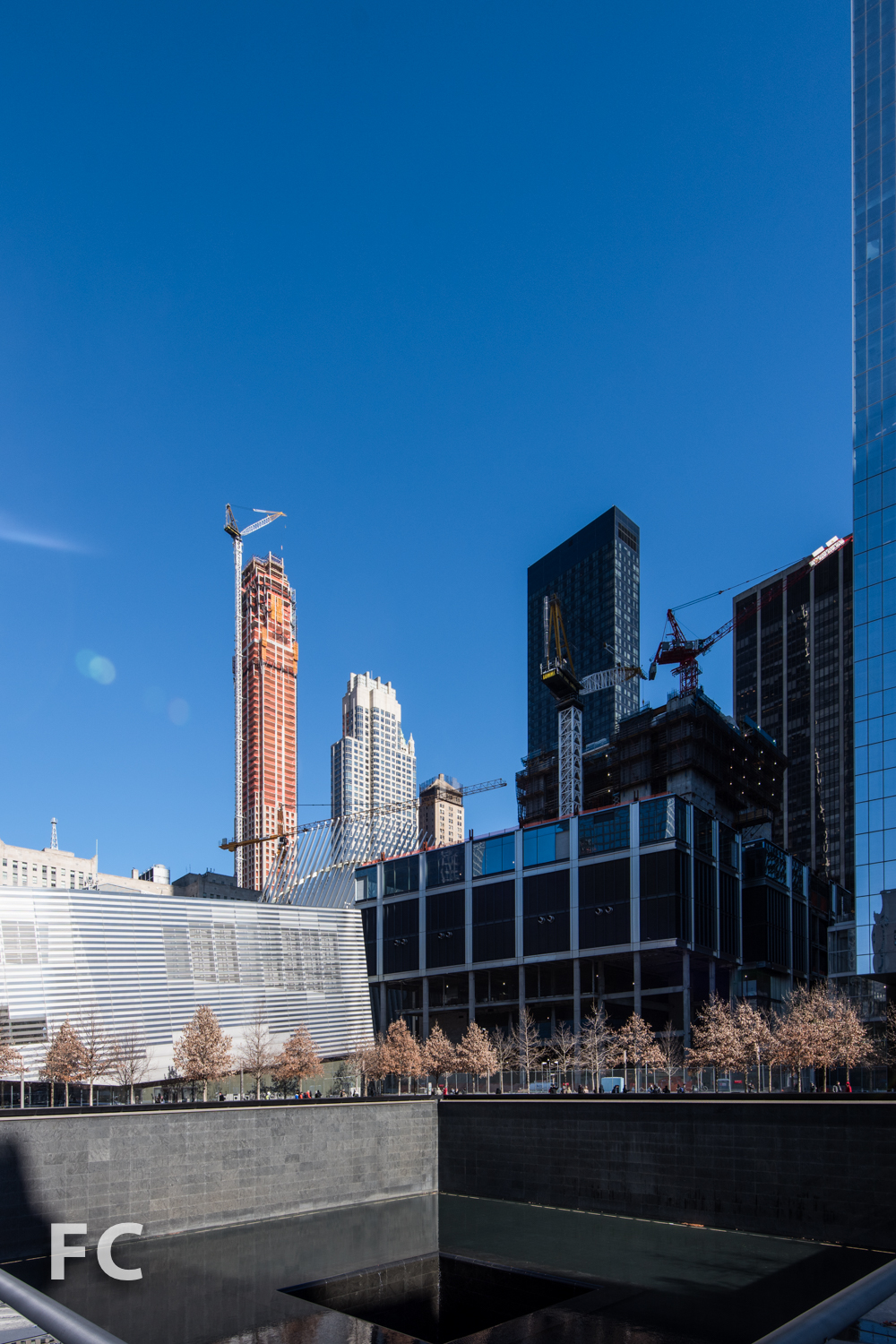
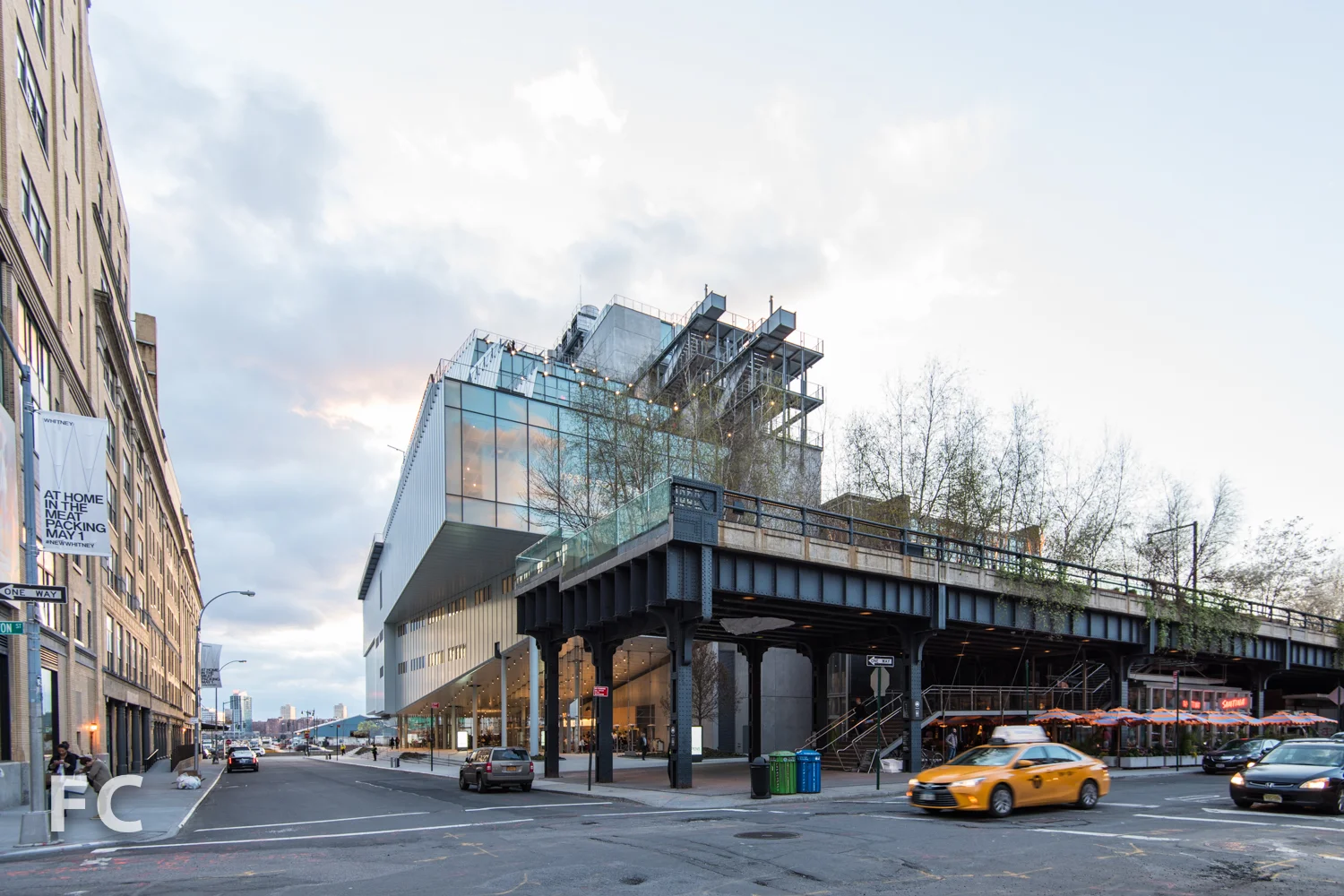
Ungainly and awkward, the Whitney's $422 million, 220,000-square-foot new home asserts its presence at the High Line's southern edge. Renzo Piano's addition to the Meatpacking neighborhood is indicative of the district's decade-long transformation from working class industrial to trendy tourist destination. What started in the previous decade with the conversion of unused elevated train tracks into the High Line elevated park, has culminated in a major new museum for the city in a neighborhood now dominated by buildings from an elite group of architects.
The Whitney Museum of American Art, begun with a collection of artwork amassed by Gertrude Whitney in 1908, has called several places home in its first century of existence. Most recently the museum was located on the Upper East Side, in a building designed by Marcel Breuer in 1966, at the corner of Madison Avenue and East 75th Street. Breuer's building, with its stone clad, inverted ziggurat form, was also considered at its opening to be awkward and panned for its unusual massing. With time, the building gained acceptance but was never able to adequately hold the museum's vast collection.
The Whitney Museum by Marcel Breuer, 1966.
Many attempts were made to expand the museum at its Upper East Side location, with designs from Norman Foster, Michael Graves, OMA, and finally Renzo Piano. Given the scale of the neighborhood and the historic value of buildings on site and adjacent, large scale expansion plans proved too contentious to realize.
With the advent of the High Line in 2009, properties that surrounded the park gained new value and the exodus of industrial businesses in the area left behind many sites ripe for new construction. Realizing the futility of its expansion plans at the Breuer building, the Whitney brokered a deal with the city of New York for a site at the southern entrance to the High Line and occupied by a meatpacking business. While the business has remained on the northern half of the massive site, the Whitney's deal with the city allows them to acquire the remaining half should the business relocate elsewhere.
Program study models.
Massing study models.
Presentation model of final design.
The Whitney Museum by Marcel Breuer, 1966.
Piano's building is arranged with gallery spaces and other public functions in the southern half, while offices for the museum's staff, education programs, and other support spaces occupy the northern half. At the primary public corner, where Gansevoort intersects Washington Street, the Whitney engages the public at both street level and the High Line as the building's form folds skyward at the corner of Gansevoort and Washington Street, creating a multi-story volume enclosed by vast expanses of glass. Piano uses this element in conjunction with the more solidly clad galleries cantilevered above to subtly invoke the Breuer building's iconic massing, a motif that will reoccur throughout. The folded facade also evokes Diller Scofidio + Renfro's overhaul of Lincoln Center's Alice Tully Hull (renovated, 2009), where a double height entry is also formed by peeling up the building's original travertine facade. For the Whitney, this space houses Danny Meyer's latest restaurant, Untitled. Stretching along the restaurant's Gansevoort Street frontage, the open kitchen visually dominates the space. At night, the scene from the street is reminiscent of Edward Hopper's Nighthawks, with the patrons spread out along the bar and the glow of Robert Indiana's illuminated word "EAT" artwork hanging above.
Southeast corner of the Whitney (left) and the southern entrance to the High Line (right).
Untitled restaurant from Gansevoort Street.
Restaurant entrance off of Gansevoort Street.
View of the restaurant bar from Gansevoort Street.
Main museum entrance from Gansevoort Street.
View of the museum shop at the southwest corner from Gansevoort Street.
Museum visitors enter mid-block off of Gansevoort Street into a glass enclosed 6,000 square-foot lobby that is adjacent to a free gallery and a museum shop consisting of open shelving to maintain visual porosity. Galleries on the upper floors can be accessed by a grand stair or by one of four elevators, featuring commissioned artwork in the elevator cab by the artist Richard Artschwager. Glazing above the elevator entry at ground level allows the visitor to see the machinery needed to operate, continuing an oft used theme by Piano. The concrete and steel of the stair serves as another subtle reference to the Breuer building.
Main museum entrance from Gansevoort Street.
Museum lobby.
Museum shop shelving.
Special exhibitions are housed on the eighth floor, which currently features "America is Hard to See." The show serves as a means for the Whitney to reexamine American art since 1900 with works from their vast collection that has long gone unseen. The galleries at this level feature the typical white walls and reclaimed wide-plank pine flooring found throughout the museum. Because of its top floor location, Piano has designed the ceilings as a grid work that allows in light from the sawtooth skylights, resulting in a much brighter and inviting environment to wander the galleries than the Breuer building. There, the dark tones of the stone flooring and the concrete waffle ceiling gave the galleries a heavy and dark atmosphere. Although Piano's galleries are a sharp turn from the previous aesthetic, he continually references the Breuer ceilings with the varying take on grids created at each level of galleries. On some floors the ceiling grid is present but solid while other floors reveal the conduit and ductwork of necessary services in a modern building, a muted and vertical take on Piano's first museum, the Pompidou.
On floors six and seven reside the permanent collection galleries in spaces unmatched by their previous home. Now visitors can peruse the work in vast spaces that give the pieces enough real estate to stand on their own but still create a dialogue with adjacent works. With the added space comes spectacular moments of rest and reflection, where visitors can sit at one of two large walls of glass and take in the High Line in the morning light from the east facade or the setting sun from the west facade's window. Moments of connection to the surrounding neighborhood can even be experienced while in the midst of perusing the galleries, as slots of space cut through gallery walls leading to the facade's glazing.
Not to be outdone, the 13,000-square-feet of outdoor galleries and terraces provide additional opportunities to pause and reflect. Views of the city skyline serve as a backdrop to outdoor cafe seating and several large sculptures. On the fifth floor outdoor gallery, the Whitney has commissioned a site specific work by Mary Heilmann, Mary Heilmann: Sunset, which features colorful chairs scattered about the terrace that visitors can use. Also included is a projected film and panels of colorful shapes that mimic the stepping of the building's terraces.

At the northern half of the building, Piano has located the support space for the Whitney's staff, which has grown steadily in recent years. Like the galleries, these spaces are generous in size and provide ample light and views to the neighborhood.
With the opening of the Whitney, the city has gained another spectacular cultural destination. Yes, it's exterior is a quirky wrapper, more muscle than beauty, but the interior more than compensates with its spot on take on the contemporary museum. Piano expertly crafts a museum that accommodates the visitor with the right mix of galleries and leisure space, allowing the museum to coexist with, rather than be consumed by, the commercial program of contemporary institutions. Like the Breuer building, Piano's structure will likely be embraced by most over time, as visitors forgive its exterior clumsiness for the expertly crafted experience within.
Architect: Renzo Piano Building Workshop (Design Architect), Cooper Robertson (Executive Architect); Structural Engineer: Robert Silman Associates: MEP Engineer: Jaros, Baum & Bolles; Facade Consultant: Heintges; Landscape Architect: Piet Oudolf with Mathews Nielson Landscape Architect; General Contractor: Turner Construction; Client: Whitney Museum of American Art; Program: Museum; Location: Meatpacking District, New York, NY; Completion: 2015.
12 East 13th Street
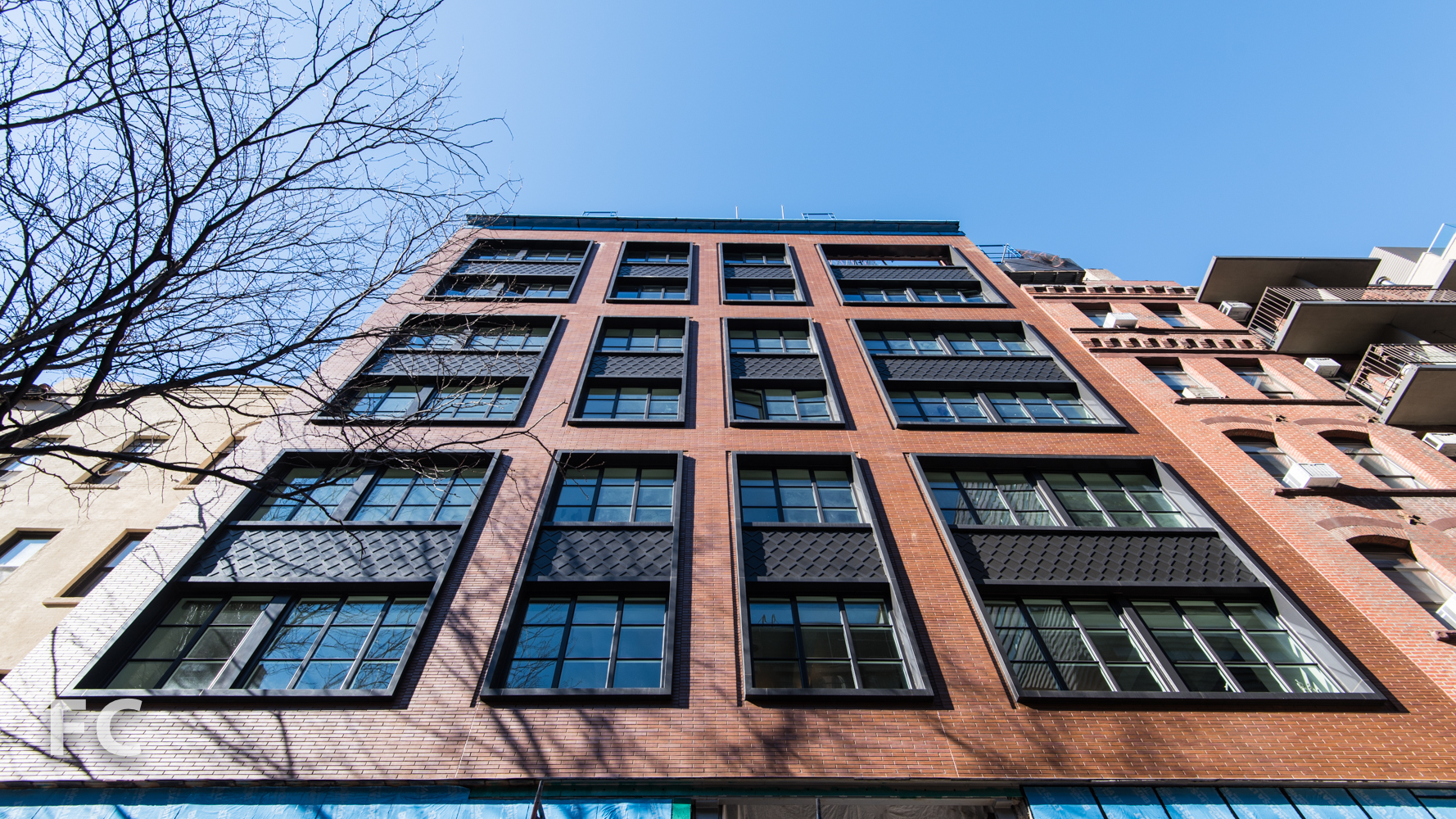
Construction scaffolding has started to come down at DHA Capital and Continental Properties' 12 East 13th Street in Greenwich Village, revealing its brick and glass facade. The former 8-story parking garage has been converted by CetraRuddy into eight residences, replacing the facade and adding a 4-story metal and glass penthouse.
A burnished orange-red Roman brick clads the 8-story primary street facade, punctuated by four bays of industrial-style windows grouped into vertical columns of two. The black metal spandrel that divides the windows contains a chevron motif inspired by a pattern from the original facade. With additional details like a depressed border of brick surrounding each window bay, the facade of the base building blends nicely with the brick and metal structures which surround it.
Northeast corner from East 13th Street.
Northeast corner.
North facade from East 13th Street.
Facade detail.
Northwest corner from East 13th Street.
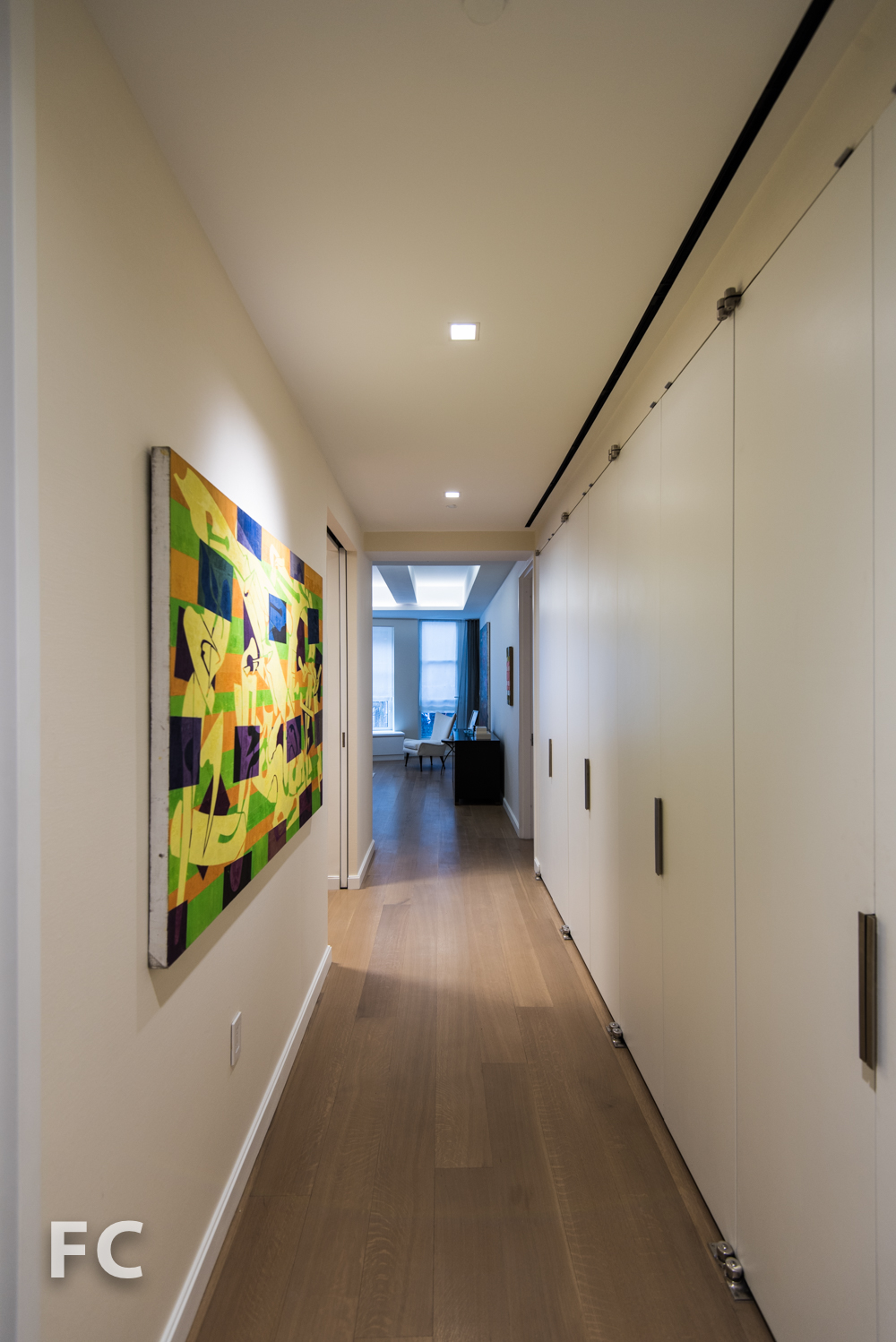
Inside, most lower units occupy the full 4,816 square-foot floor plate while the upper floors feature a duplex and a triplex in the added penthouse structure. An open plan along the 67-foot street front accommodates living and dining spaces in one large great room. Industrial style black metal and glass sliding doors act as moveable partitions, allowing residents to close off the family room next to the kitchen. Existing steel columns have been preserved and featured in the living and dining area, complimenting the interior design's blending of modern and industrial. Much of the interior kitchen and bath cabinetry and door hardware have been custom designed by the architect and also reflect this aesthetic.
Living and dining space.
Living room.
Family room.
Move-able partitions and existing columns.
Move-able partitions and existing columns.
Family room.
Kitchen.
Bedrooms and accompanying bathrooms are located along the back half of the floor plate. Most units contain four bedrooms and bathrooms, as well as a powder room off the living space.
Powder room.
Powder room floor tile.
Secondary bedroom.
Secondary bathroom with custom white lacquer vanity including water resistant galvanized drawer fronts.
Detail of the water resistant galvanized drawer fronts.
Master bedroom.
Master bedroom.
Master bathroom vanity featuring rift-cut white oak cabinetry and a countertop of polished Calacatta Borghini marble.
Freestanding 6 foot soaking tub.
Master bathroom shower.
Custom door hardware in the master bathroom.
Half of the units will contain outdoor space, including an 807-square foot terrace on the third floor, a 1,760-square foot terrace on the ninth floor for the duplex, and space on the tenth floor for the triplex.
Amenities for the building include the much touted automated parking system that allows residents to enter the building in privacy while their car is parked robotically on the second floor garage. Additional amenities include gym, bike storage, and private storage unit.
Architects: CetraRuddy; Developers: DHA Capital and Continental Properties; Public Relations: M18; Program: Residential, Retail; Location: West Village, New York, NY; Completion: 2015.


551 West 21st Street
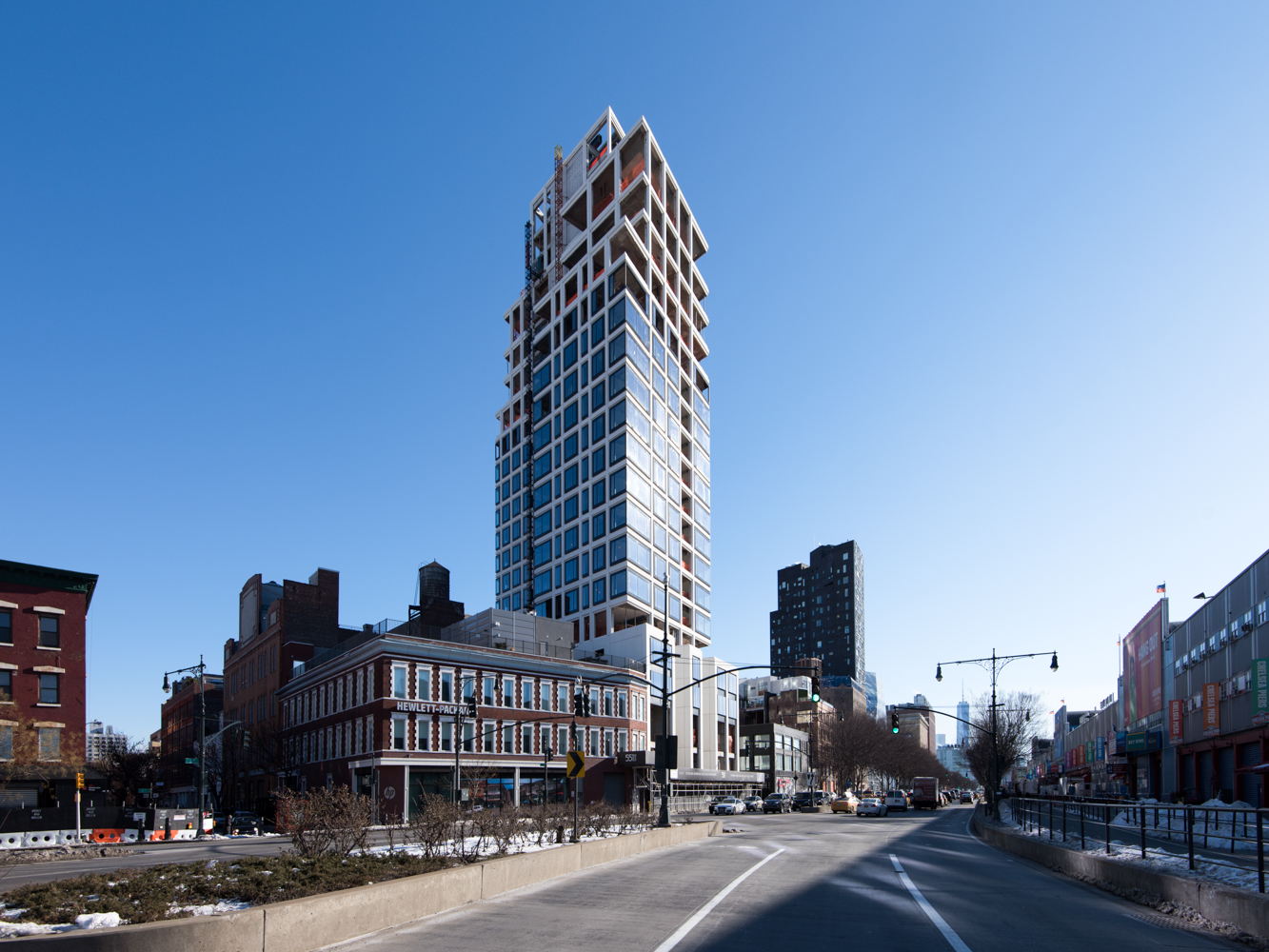
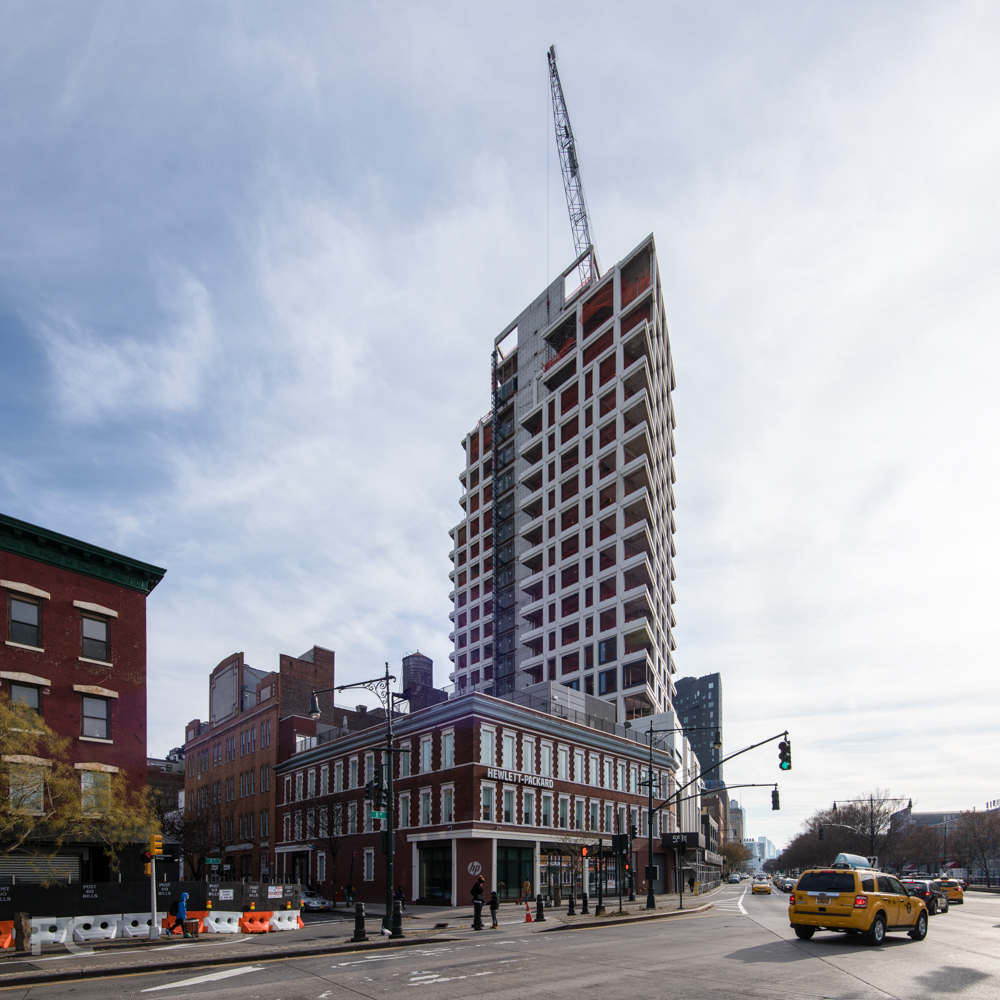
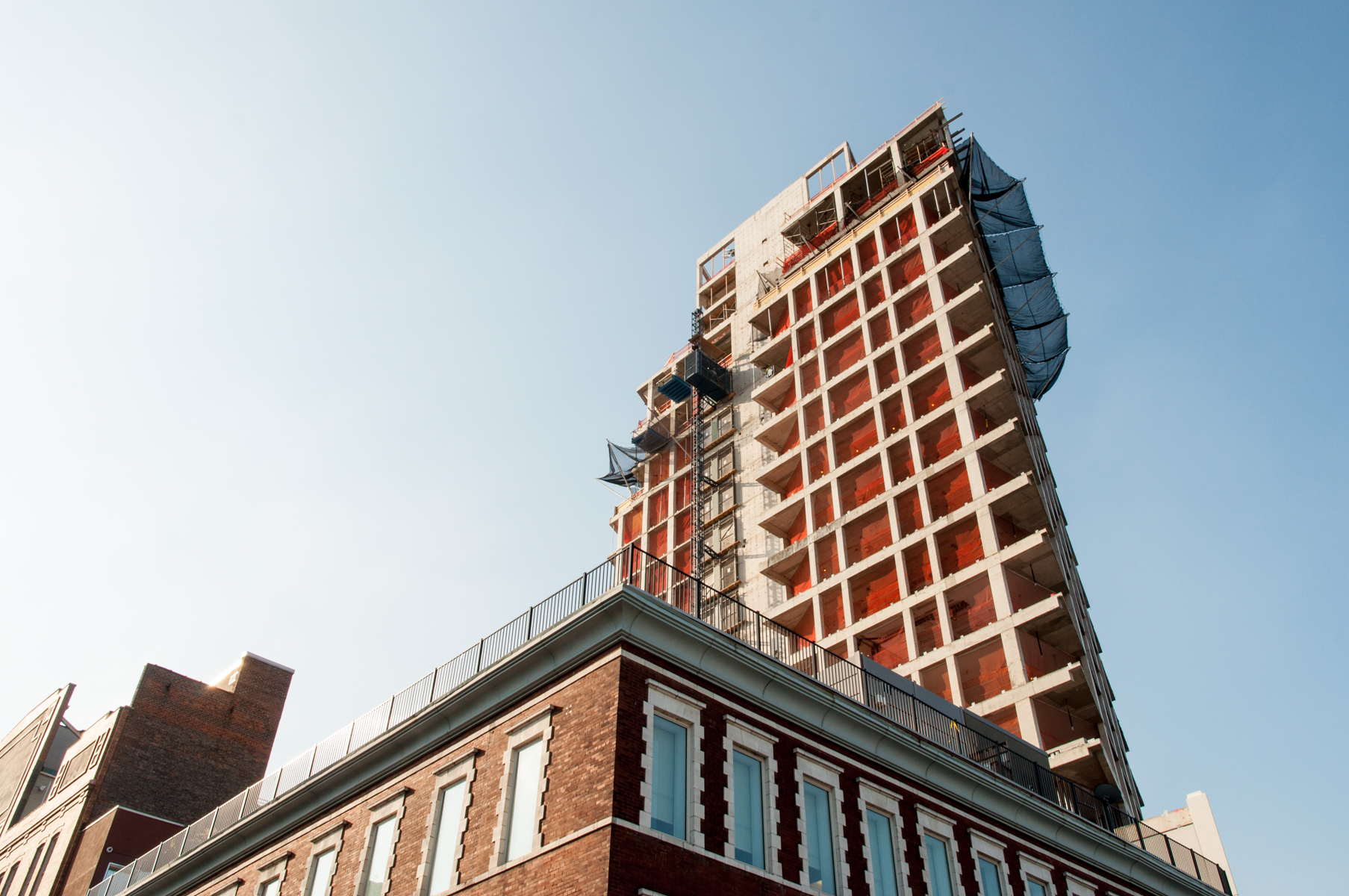
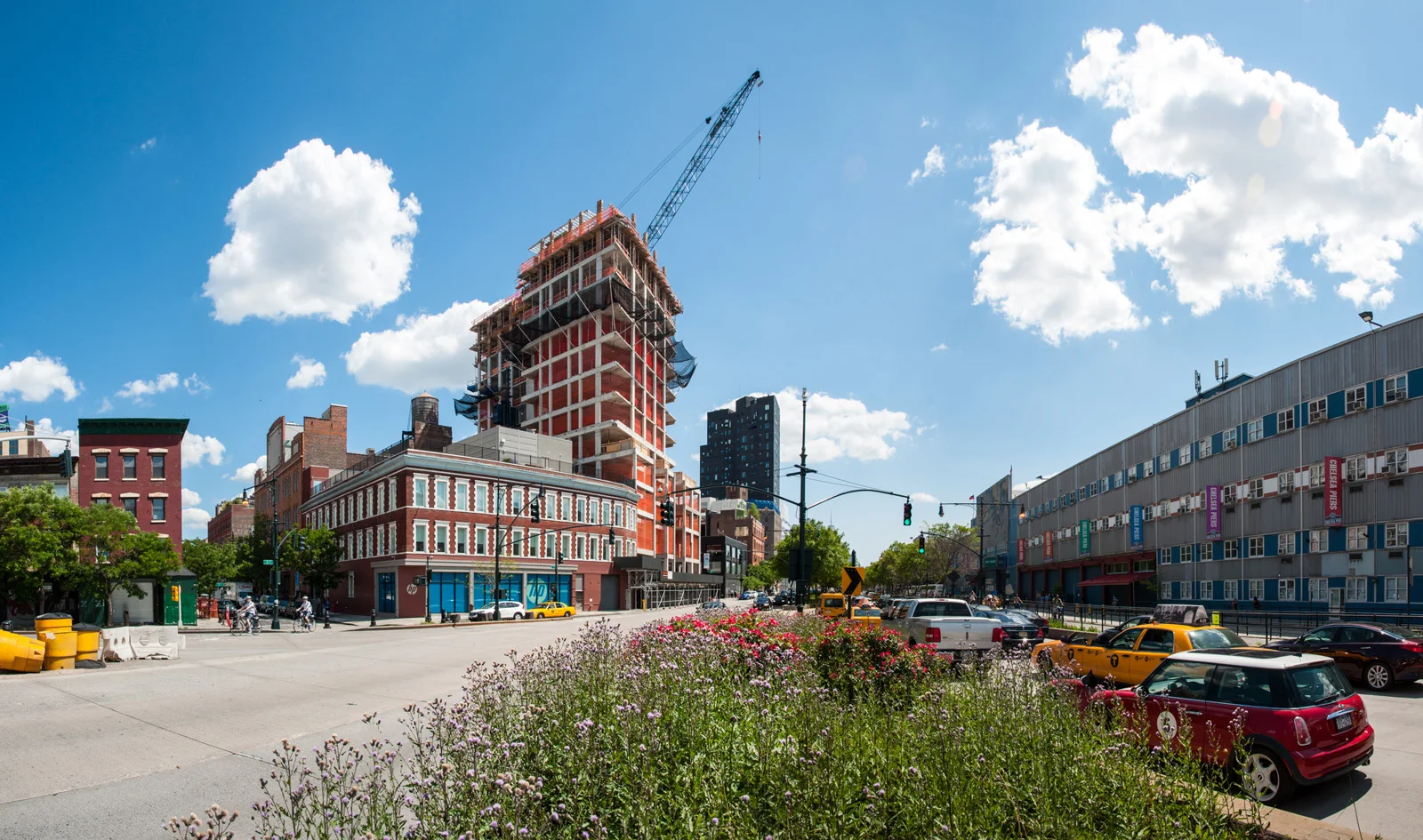
Since the previous update in December, significant progress has been made on window installation at Foster + Partners' residential tower near the High Line, 551 W 21. Windows have reached the 15th floor at the 19-story, 44-unit luxury condo tower. The windows feature a metal surround and are set within a facade of white cast-concrete panels. Construction is slated for completion in the fall of 2015.
North facade from 11th Avenue.
Northwest corner from 12th Avenue.
Northwest corner of the tower.
West facade from 12th Avenue.
West facade from 12th Avenue.
Southwest corner from 12th Avenue.
South facade from West 21st Street.
Looking north on 12th Avenue.
Looking north on 12th Avenue with IAC Headquarters (right) and 100 Eleventh Avenue (center).
Architects: Foster + Partners (Design), Beyer Blinder Belle (Executive); Developers: SR Capital; Program: Residential; Location: Chelsea, New York, NY; Completion: 2015.

7 Bryant Park
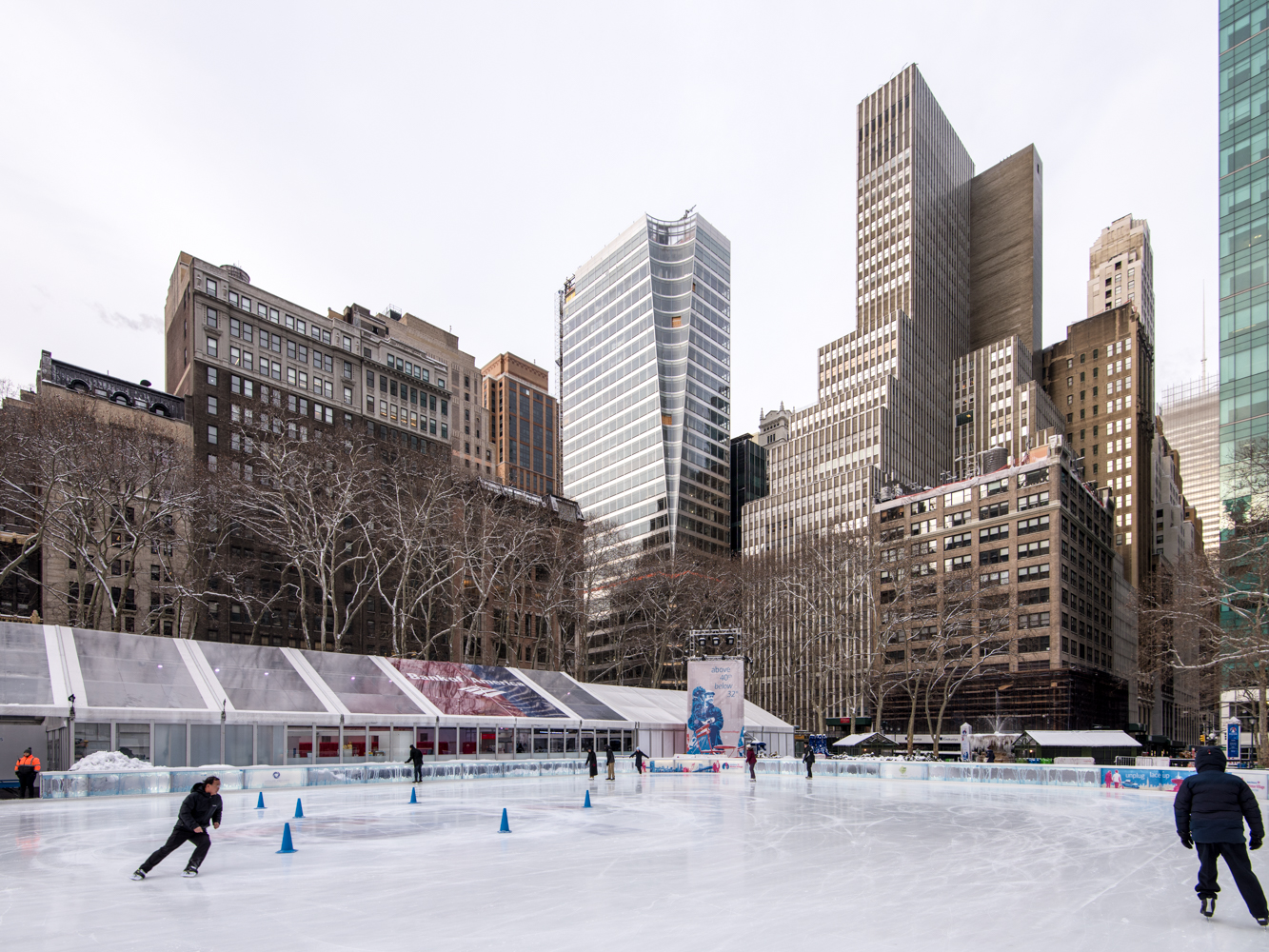
Installation of curtain wall is almost complete at Pei Cobb Freed's 7 Bryant Park, a 450-foot-tall, 30-story office building on the fringes of Bryant Park in Midtown Manhattan. The tower joins other recent additions to the area, like COOKFOX's angular One Bryant Park. Overall, the tower's form is a simple rectangular extrusion with requisite zoning setback on the tenth floor and a conical subtraction at the northeast corner. This rather odd massing gestures faces the park and provides the building's signature element. The design of the curtain wall is a basic glass and linen finish stainless steel spandrel panel that gives the building a heavily striped appearance, bucking the recent trend of suppressing the solid spandrels in other new office buildings throughout the city. When completed later this year, the tower will bring 471,000 rentable square feet to the area, including 6,200 square feet of ground floor retail.
Northeast corner from Bryant Park.
Looking west from Bryant Park with One Bryant Park (far right) and 7 Bryant Park (far left).
Frozen fountain in Bryant Park.
Northeast corner from Sixth Avenue.
Detail of canopy and conical incision at the northeast corner.
North façade from West 40th Street.
Northwest corner from West 40th Street.
East façade from Sixth Avenue.
Southeast corner from Sixth Avenue.
Architects: Pei Cobb Freed & Partners Architects LLP; Structural Engineer: Thornton Tomasetti; MEP Engineer: Jaros Baum & Bolles; Developer: Hines with Pacolet Milliken Enterprises; Program: Office, Retail; Location: Midtown, New York, NY; Completion:2015.

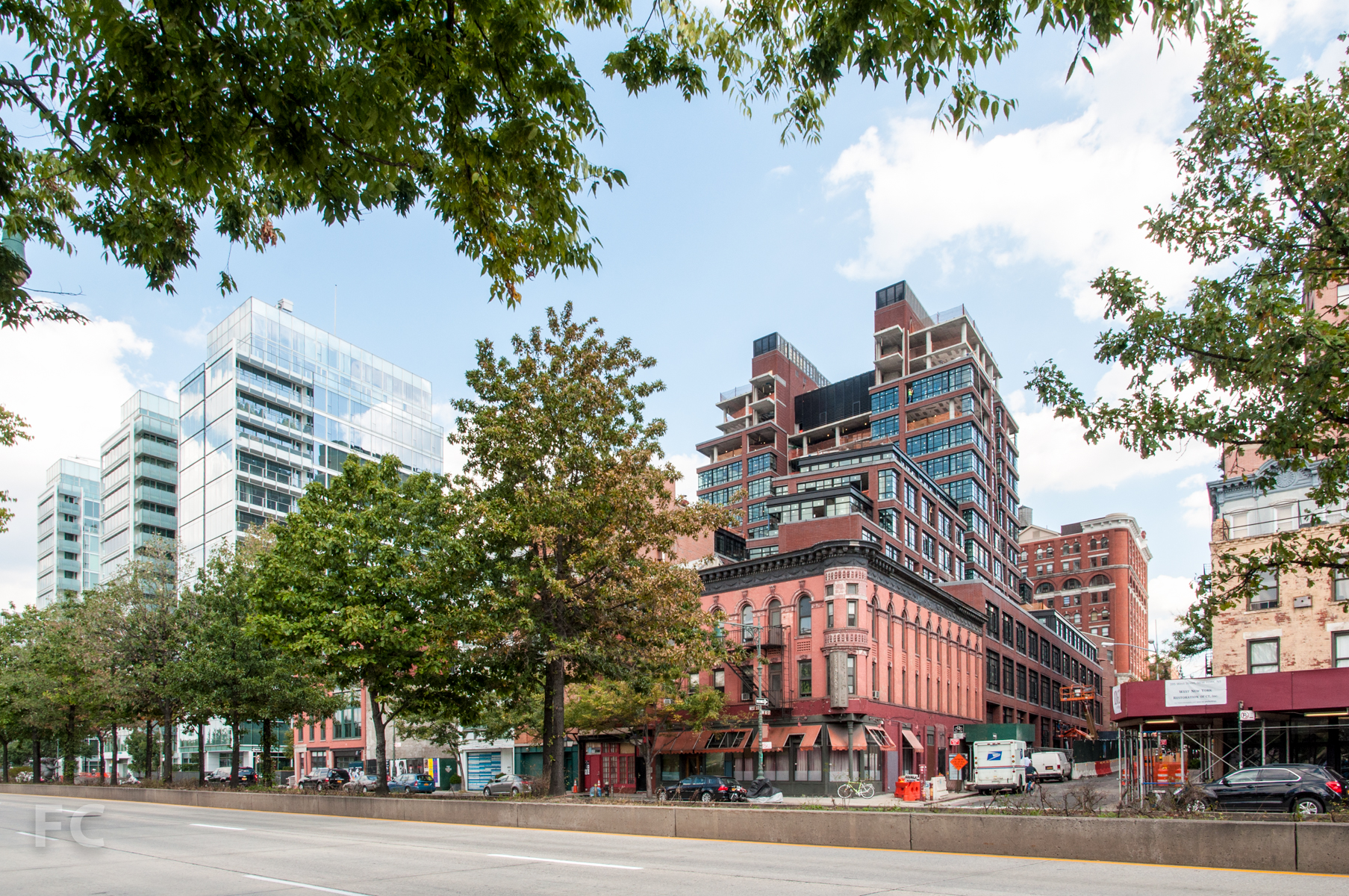
150 Charles Street
Construction is in the latter stages at COOKFOX's 150 Charles, the 14-story, 98-unit building in the West Village. The project incorporates the structure of the abandoned Whitehall warehouse for the lower podium floors. Above, two towers are joined by a middle volume and cascade down to the Hudson River, allowing for spectacular views while reducing the visual impact on the neighborhood. The material palette of brick and industrial style windows helps the project to mesh well with the older buildings in the neighborhood, a stark contrast to the glassy neighboring Richard Meier towers of the previous decade.
The southeast corner from West 10th Street.
Detail of the south facade.
The south facade from West 10th Street.
The southwest corner from West 10th Street.
The stepping upper floors from West Street.
The southwest corner from West Street.
The northwest corner from West Street.
The west facade.
View from Pier 46 at the Hudson River Park.
View of 165 Charles (left) and 150 Charles (right) from Pier 46 at the Hudson River Park.
The northeast corner from Charles Street.
The north facade of the podium on Charles Street.
Detail of the northwest corner of the facade.
150 Charles reflected on the glass curtain wall of 165 Charles.
The east facade from Washington Street.
Architects: COOKFOX Architects; Program: Residential; Location: West Village, New York, NY; Completion: 2015.

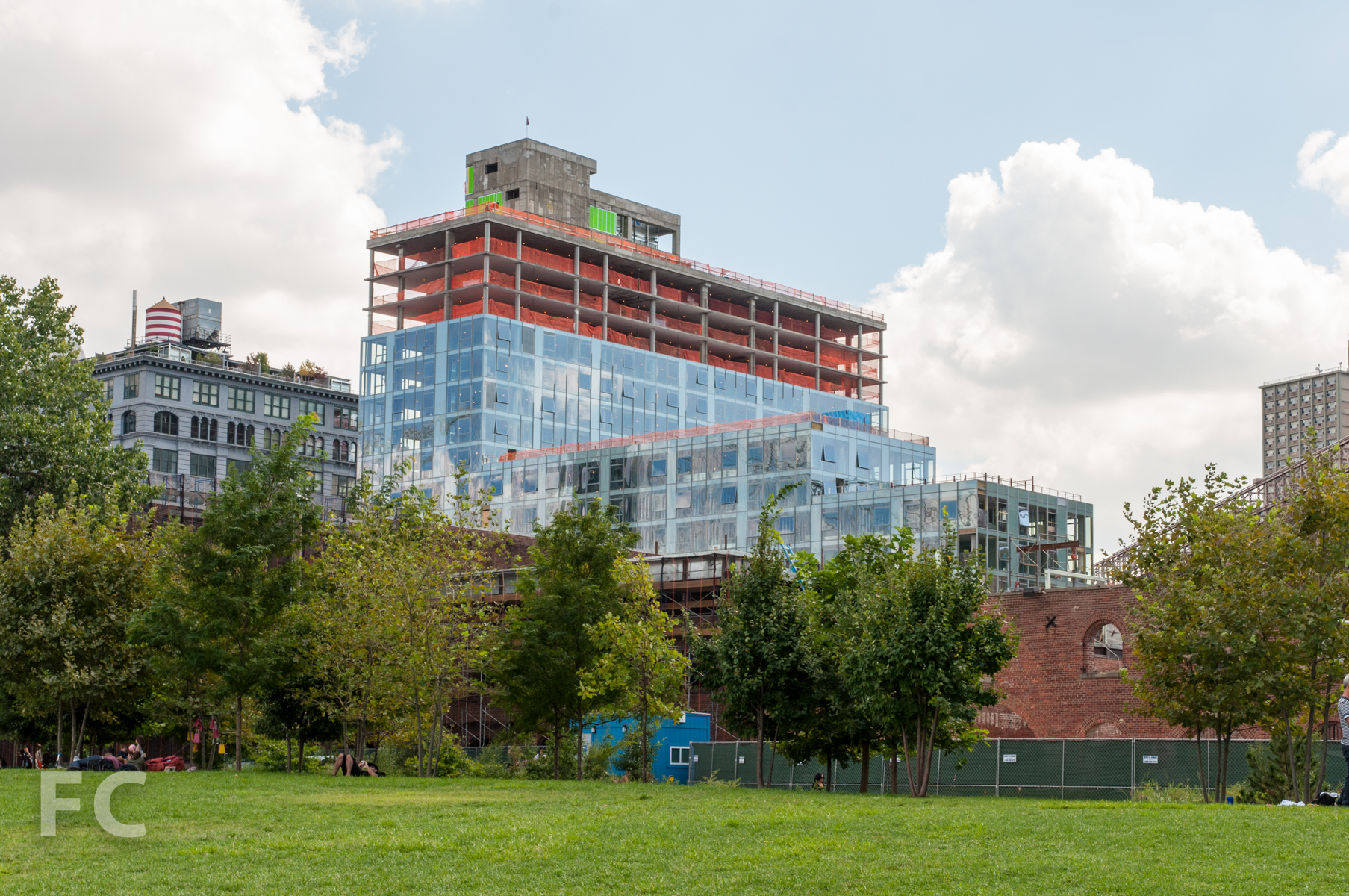
60 Water Street
Curtain wall installation has reached the 14th floor at LEESER Architecture and Ismael Leyva Architect's 17-story, 290-unit rental near Brooklyn Bridge Park. The glass curtain wall features vertical fins, yet to be installed, of opposing triangles that define irregular shapes which help to break down the relentless glass envelope. The Two Trees development will also contain a 300-seat middle school and retail at its base.
The southwest corner rising above the Brooklyn Bridge approach structure.
The northwest corner from Water Street.
The northwest corner from the intersection of Dock Street and Water Street.
The northeast corner from Water Street.
Reflection of the Brooklyn Bridge in the curtain wall.
Reflection of the Clock Tower building in the curtain wall.
The north façade from Water Street.
Detail of operable window and frit pattern.
Detail of entry canopy at northwest corner.
Looking southeast from Empire Fulton Ferry Park.
The southwest corner from Prospect Street and Cadman Plaza.
Architects: LEESER Architecture and Ismael Leyva Architects; Developer: Two Trees; Program: Residential, Education, Retail; Location: DUMBO, Brooklyn, New York, NY; Completion: 2015.